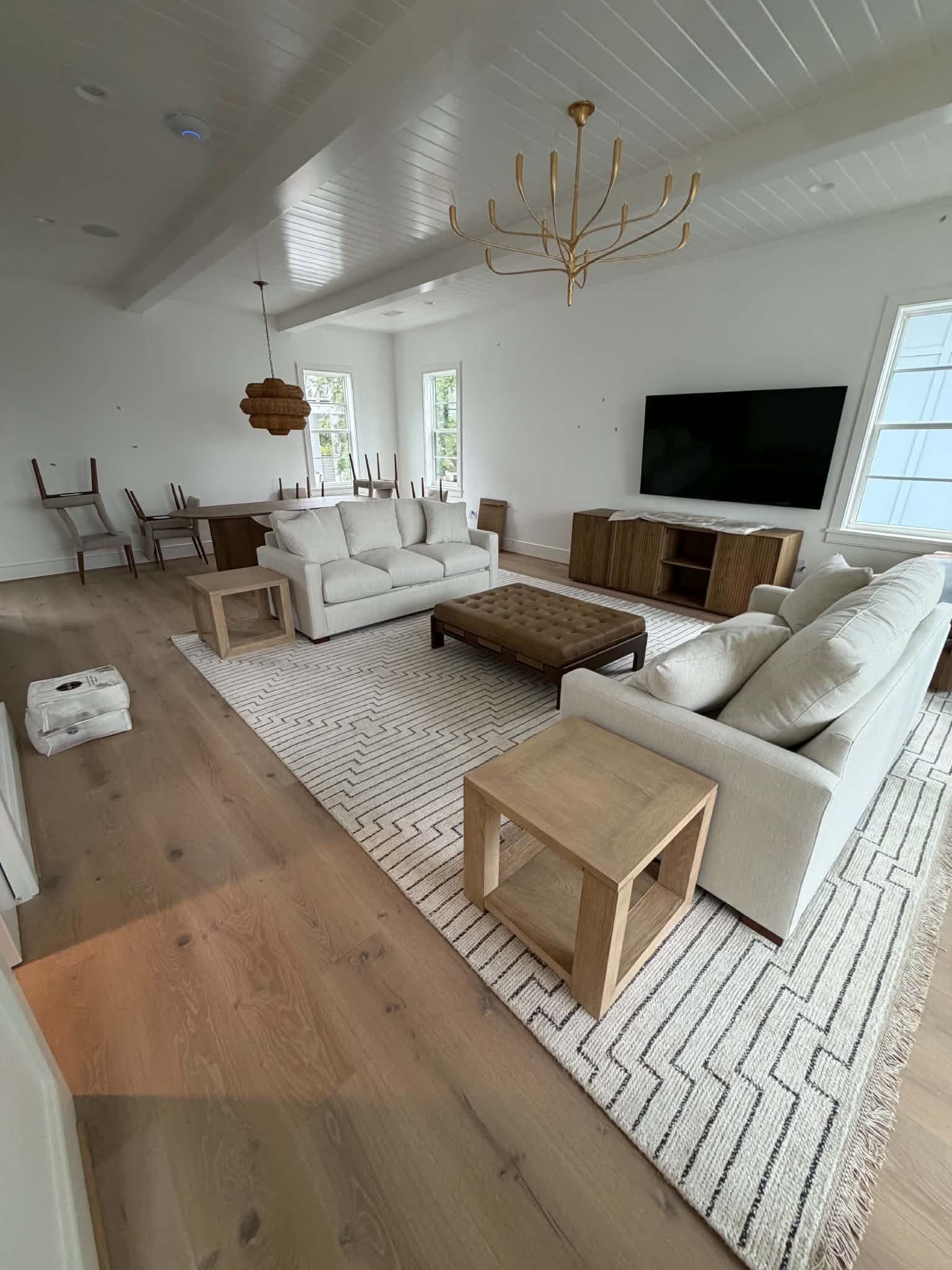
Moving Into a New Beach-House Build on the Emerald Coast: How to Protect Floors, Stairs, and Finishes
By Joshua B McGrew, co-owner, Beach House Moving
New construction on 30A and across the Panhandle comes with fresh floors, tight stairwells, and finishes that are easy to damage on move-in day. Here's how we approach it.
Why New Construction Moves Require Extra Attention
New construction homes are delivered in perfect condition. Move-in day is the first day that changes. Fresh hardwood, tile grout that's still curing, painted walls with no scuffs yet — all of it is at risk the moment a heavy piece of furniture comes through the door. We treat protecting the home as part of the job, not as something the homeowner has to ask for.
The most common finishes we move into along 30A and across the Panhandle right now: wide-plank engineered white oak in the main living areas — often in lighter driftwood or veiled-white tones with a matte finish — followed by large-format porcelain in kitchens and wet zones, polished concrete in modern Inlet Beach and Watersound builds, and waterproof LVP in lower levels and kids' rooms. All of them look incredible on day one. All of them show a scratch if you're not careful.
Floor Protection Is Standard, Not Optional
We lay floor runners before the first item comes in. On hardwood, that means felt pads under every furniture leg and runners on every walking path. On tile, we use protection board over the grout lines. On carpet, plastic film. None of this is billed as an extra — it's part of how we move.
Our standard setup: Ram Board or heavy rosin paper taped down over every high-traffic path — it's breathable, so it doesn't trap coastal humidity under hardwood the way plastic sheeting can. Felt furniture sliders under anything heavy. Carpet film on any LVP transition zones. For polished concrete, we add plywood sheets under dollies and appliances to distribute the weight. One thing we learned early: skip the plastic sheeting directly on fresh hardwood in summer — the humidity under it causes sweating that can mark the finish before you've even moved in.
Stairs, Door Frames, and Corners
Stairwells in new construction are usually the tightest part of the job. Door frames get corner guards. Banisters get padded. If something is going to get dinged, it happens here — and we plan for it before it does.
The tightest job we've worked was a beachfront home in Rosemary Beach — a fresh white-oak staircase, a 90-degree turn on the landing, and a king-size platform bed that needed to be partially disassembled to navigate it. Moving blankets doubled on the railing, corner guards on every door frame, and a slow methodical carry. No marks. That's the standard.
Coordinate With Your Builder Before Move Day
Some builders have specific move-in requirements — elevator reservations, entrance restrictions, permitted move-in windows. We ask about all of this when you book so we can plan accordingly. The builder's timeline is our timeline.
Related services:
Frequently Asked Questions
Do you provide floor protection for new-construction move-ins?
Yes — floor runners, corner guards, and furniture pads are standard on every move. No upcharge. Call (850) 842-1962 before your move-in date.
Can you coordinate move-in timing with a builder or property manager?
Yes. Give us the builder's contact and move-in requirements when you book. We'll handle the coordination.