Is My Florida Mover Legit? How to Check a License, Insurance and Estimate
By Joshua B McGrew, co-owner, Beach House Moving
Florida movers must register with FDACS, carry insurance and give you a signed written estimate. How to check any mover in five minutes, using ours as the example.
Every mover that moves household goods within Florida has to register with the Florida Department of Agriculture and Consumer Services (FDACS), carry insurance, and put its price in a signed written estimate and contract before it touches a box. That is chapter 507 of the Florida Statutes. This guide shows how to check any mover against it in about five minutes, using our own registration, Fla. Mover Reg. No. IM4125, as the worked example. It is general information, not legal advice.
The five-minute check
Run these checks on any mover before you sign anything.
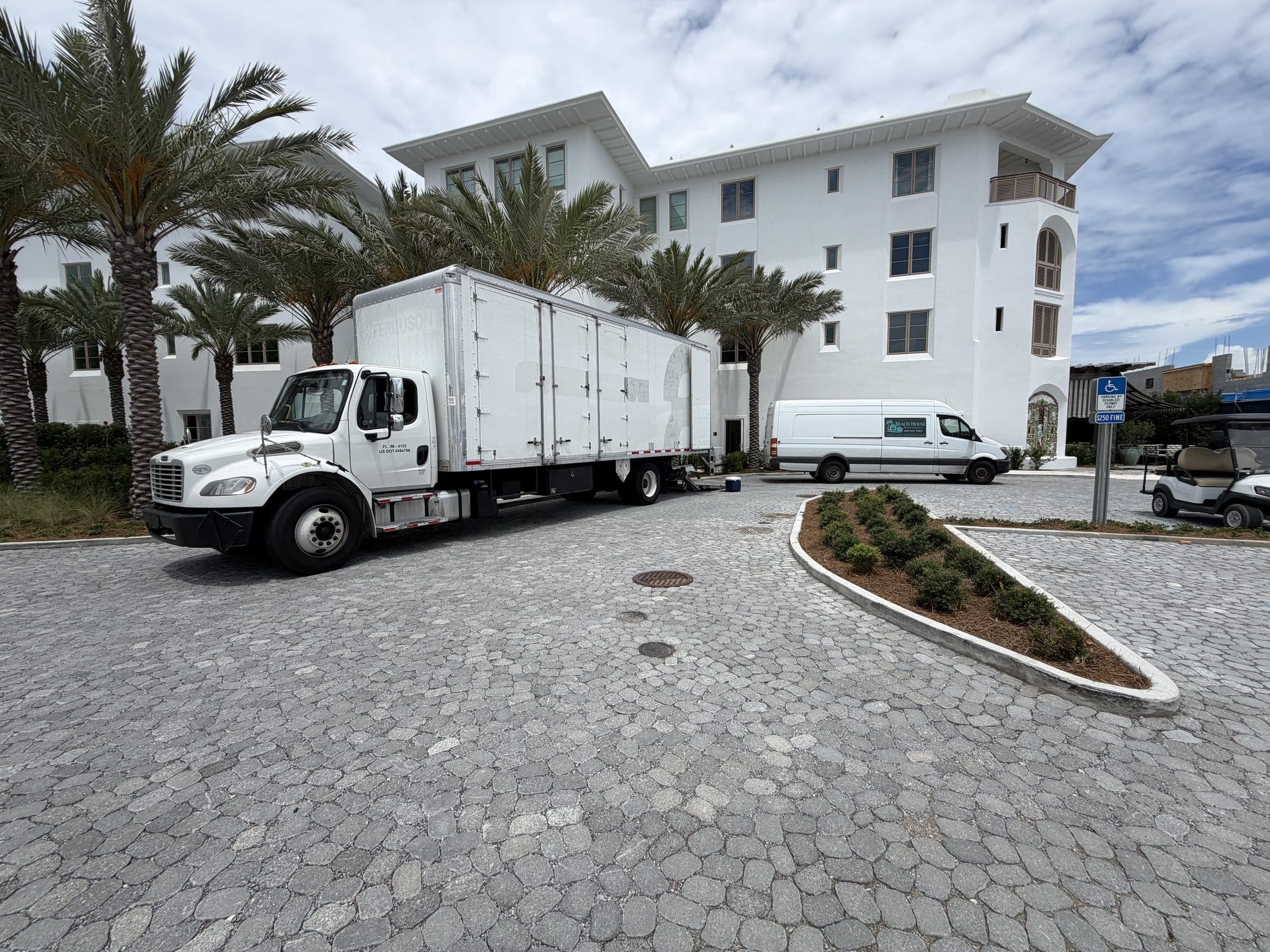
- Find the number. Florida requires every mover ad to show "Fla. Mover Reg. No." or "Fla. IM No." with the number, the driver-side door of every truck to show it in letters at least 1.5 inches tall, and every estimate and contract to state that the firm is registered with the State of Florida as a mover.
- Look it up. Search the FDACS Business/License Search by business name or registration number, license type "Intrastate Movers" (or "Moving Broker"). FDACS is moving to a new system, so if a mover does not show up, search the legacy database too.
- Or call FDACS at 1-800-HELP-FLA (1-800-435-7352). En español: 1-800-FL-AYUDA (1-800-352-9832).
- Get it in writing. Before any work, a registered mover has to give you a written estimate and a written contract, signed and dated by you and the mover.
Who has to register in Florida
Anyone who operates as, or advertises as, a mover or moving broker for a move that starts and ends in Florida has to register with FDACS first (§507.03), whatever local licenses they also hold. Registration is renewed every two years at $300 a year, and it cannot be sold or transferred to another company. Operating without it can bring a cease-and-desist order and fines up to $5,000. Chapter 507 does not cover shipments the federal, state or a local government contracts for, so a government-arranged military household-goods shipment is not an FDACS matter, while a PPM where you hire the mover yourself is a private contract. More on that in our PCS guide for Eglin and Hurlburt.
Check us: Fla. Mover Reg. No. IM4125
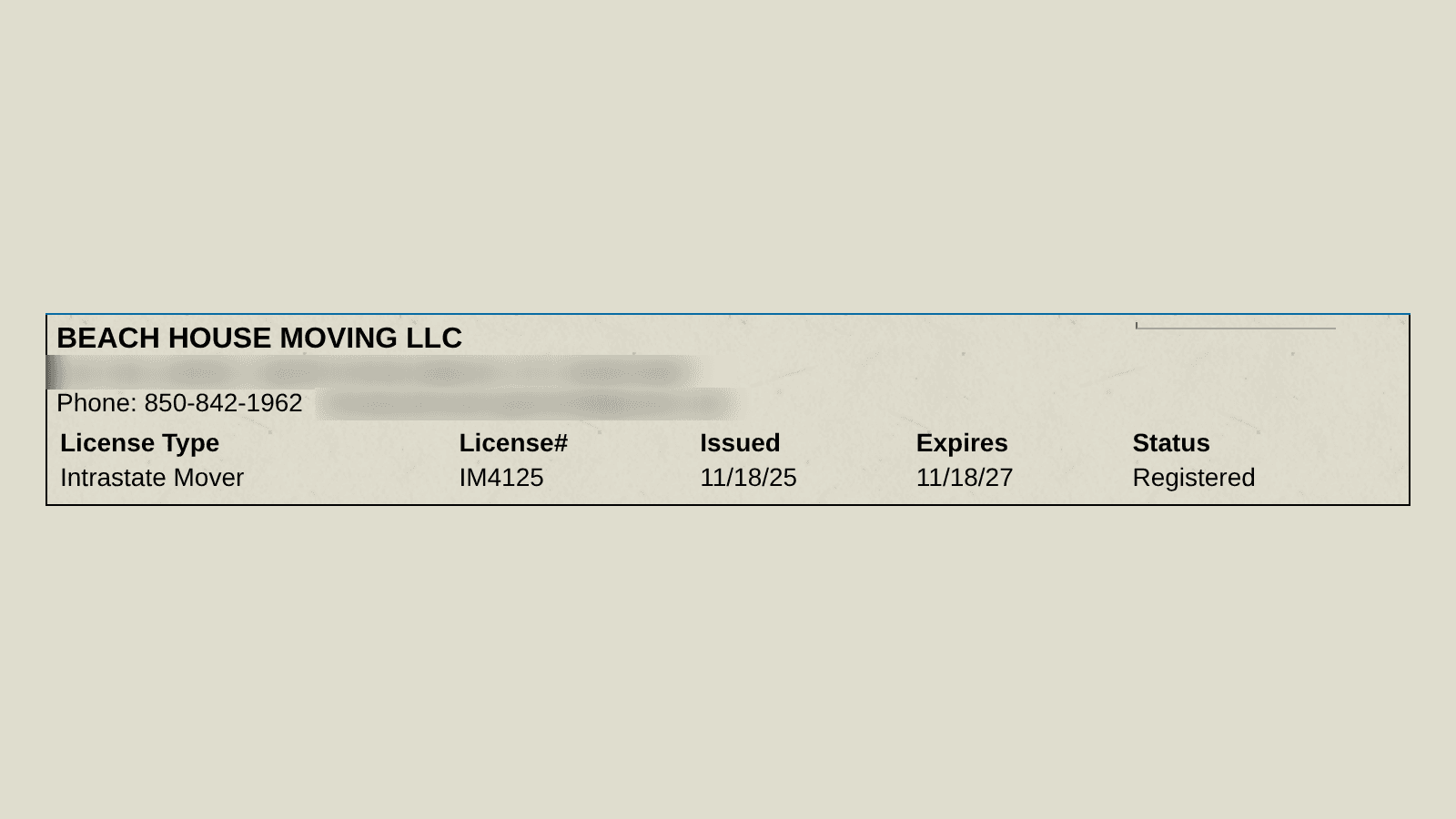
Here is the same check run on us. FDACS is moving to a new license system, and our registration currently shows in its legacy lookup, not the new one, which is exactly why FDACS tells you to search both. From the FDACS Business/License Search, follow the link to the legacy database, choose license type "IM-Intrastate Mover" and search "Beach House Moving" or IM4125. On October 3, 2026, the listing showed Beach House Moving LLC as a registered intrastate mover, IM4125, valid through November 18, 2027. If you would rather call, give 1-800-HELP-FLA the same number.
What insurance a Florida mover has to carry
Florida sets floors (§507.04). A mover must carry cargo liability insurance of at least $10,000 per shipment for loss or damage it causes. A mover running two or fewer vehicles may post a $50,000 performance bond or a $50,000 certificate of deposit in a Florida bank instead, and moving brokers must keep one. Truck liability minimums run from $50,000 per occurrence for trucks under 35,000 lb to $300,000 for trucks of 44,000 lb and up. The insurer must be licensed in Florida and must name FDACS as certificate holder, so FDACS hears about a lapse, and it must suspend the registration if coverage is not kept up.
The 60-cents-a-pound rule
Florida's minimum valuation for your goods is 60 cents per pound per article, and any contract term that limits the mover's liability below that is void. A mover that limits its liability must tell you the valuation rate in writing when you sign the estimate and contract, before any work, and must tell you that you can buy valuation coverage if it offers it. Ask every mover you compare what its valuation options are, and get the answer in writing. Our coverage limits and options are on our coverage and claims page.
Estimates, contracts and how you can pay
Before any work, the estimate and contract must list the mover's name, phone and physical address; the date prepared and the proposed move dates; your name and both addresses; where your goods will be held, including during a fee dispute; an itemized breakdown and total of every cost and service, including any broker fee; and the payment methods accepted (§507.05). The mover has to accept at least two of three payment types: cash, cashier's check, money order or traveler's check; personal check; or credit card.
Can a Florida mover charge more than the estimate?
Chapter 507 sets no percentage cap on overruns for moves within Florida. Its protection is paperwork: any price change has to be written into an amendment to the contract that you sign (§507.11). The well-known 110% rule is a federal rule for interstate moves. For a move that starts and ends in Florida, the signed amendment is what protects you.
Moving within Florida vs. leaving the state
| Rule | Within Florida (intrastate) | Leaving Florida (interstate) |
|---|---|---|
| Regulator | FDACS, Florida Statutes chapter 507 | FMCSA, 49 CFR Part 375 |
| Look the mover up | FDACS Business/License Search, or 1-800-HELP-FLA | FMCSA SAFER Company Snapshot |
| Number to look for | "Fla. Mover Reg. No." or "Fla. IM No." | USDOT or MC number |
| Estimate | Signed written estimate and contract before any work | Written estimate after a physical survey (unless you waive it in writing), marked binding or non-binding |
| Price above the estimate | No percentage cap; any change needs an amendment you sign | Non-binding estimate, collect on delivery: the mover must deliver when you pay up to 110% of the estimate, plus services you added |
| Paperwork you should get | Estimate and contract stating the Florida registration | "Your Rights and Responsibilities When You Move" and "Ready to Move?" |
| Complaints | FDACS, 1-800-HELP-FLA | FMCSA National Consumer Complaint Database |
Red flags
Any one of these is a reason to slow down and check harder.
- A large deposit, or a demand for cash or a wire transfer up front. Florida law sets no cap on deposits, but the Florida Attorney General lists a large up-front deposit or cash payment as a red flag, and the Department of Defense warns military families about cash or electronic bank deposits as a down payment.
- A quote far below everyone else's, given without a real look at what you are moving.
- A call from a broker instead of the company that will do the move. In Florida a broker cannot hand you an estimate the registered mover did not prepare and sign, and cannot use an unregistered mover.
- No registration number on the ad, the truck or the paperwork.
- A contract clause asking you to waive your chapter 507 rights. Those clauses are void.
- A company name, logo or phone number that changes between the website, the email and the truck.
If a mover holds your things for more money
Once you have paid the amount in your signed estimate or contract, plus any amendments you signed, the mover has to deliver and place your goods (§507.06). A mover may never withhold prescription medicine or goods for children, such as furniture, clothing and toys, under any circumstances. If a mover refuses a law-enforcement officer's order to release your goods after the officer finds you paid the agreed amount, or the mover cannot produce a signed estimate or contract, that is a third-degree felony (§507.11). Call local law enforcement, then FDACS at 1-800-HELP-FLA.
Two more rules most people never hear about
- A mover must tell you in writing, before the move, if anyone with access to your home, including whoever gives the estimate, has a conviction for one of the felonies listed in Florida law (§507.07(10)).
- A mover cannot put your goods in a third party's self-storage unit unless the unit is in your name and you contract with the facility directly (§507.07(11)).
Where to complain
FDACS takes complaints at 1-800-HELP-FLA or online, and the Florida Attorney General's fraud line is 1-866-9-NO-SCAM (1-866-966-7226). Chapter 507 violations also count as deceptive and unfair trade practices under Florida law (§507.08). FDACS can fine a mover up to $5,000 per violation (more for felony-disclosure violations), order it to stop operating, suspend or revoke its registration, and order restitution to customers. For an interstate move, use FMCSA's National Consumer Complaint Database. When you are comparing quotes, our pricing page shows how ours is built.
Related services:
Sources
- Florida Statutes chapter 507, Household Moving Services (2026) (checked October 3, 2026)
- FDACS: Moving Companies (checked October 3, 2026)
- FDACS Business/License Search (checked October 3, 2026)
- FDACS legacy license search (checked October 3, 2026)
- Florida Attorney General, "Scams at a Glance: On the Move" (PDF) (checked October 3, 2026)
- Military OneSource, PPM and Rogue Operators fact sheet, March 2026 (PDF) (checked October 3, 2026)
- Fla. Admin. Code ch. 5J-15 (mover registration and penalties) (checked October 3, 2026)
- Florida Statutes §570.971 (administrative fines) (checked October 3, 2026)
- 49 CFR 375.401 (interstate estimates) (checked October 3, 2026)
- 49 CFR 375.213 (booklets interstate movers must provide) (checked October 3, 2026)
- 49 CFR 375.407 (the 110% rule) (checked October 3, 2026)
- FMCSA SAFER Company Snapshot (checked October 3, 2026)
- FMCSA National Consumer Complaint Database (checked October 3, 2026)
Frequently Asked Questions
How do I check if a mover is licensed in Florida?
Search the FDACS Business/License Search for the company name or its registration number (license type "Intrastate Movers"), or call 1-800-HELP-FLA. If the mover does not appear, search the legacy database too; FDACS is moving to a new system.
What does "Fla. IM No." mean on a moving truck?
It is the mover's Florida registration number. Florida requires it on every ad, on the driver-side door of every truck in letters at least 1.5 inches tall, and on every estimate and contract. Ours is Fla. Mover Reg. No. IM4125.
What insurance does a Florida mover need?
Cargo liability insurance of at least $10,000 per shipment (movers with two or fewer vehicles may post a $50,000 bond or certificate of deposit instead), plus truck liability of $50,000 to $300,000 per occurrence depending on truck weight. Minimum valuation for your goods is 60 cents per pound per article.
Can a Florida mover charge more than the estimate?
Only through a written amendment to the contract that you sign. Chapter 507 sets no percentage cap for moves within Florida; the 110% rule is federal and applies to interstate moves.
Can a mover hold my stuff until I pay more?
Not once you have paid the amount in your signed estimate or contract plus any amendments you signed. Refusing a law-enforcement order to release your goods is a third-degree felony in Florida, and prescription medicine and children's things can never be withheld.
How much deposit should a mover ask for?
Florida law does not set a limit. The Florida Attorney General flags a large up-front deposit or a demand for cash as a red flag, so ask why before you pay one.
What's the difference between a moving broker and a mover?
A mover does the move with its own crew and trucks. A broker arranges the move and hands it to a mover. In Florida both must register with FDACS, a broker must keep a $50,000 bond or certificate of deposit, and a broker cannot give you an estimate the registered mover did not prepare and sign.