Freestanding Tub Delivery in Seacrest Beach: What Fits, What It Weighs, and Who Sets It in Place
By Joshua B McGrew, co-owner, Beach House Moving
What a freestanding tub actually weighs, the door width you really need, and what "set in place" means versus delivery. From a Seacrest Beach fixture job on 30A.
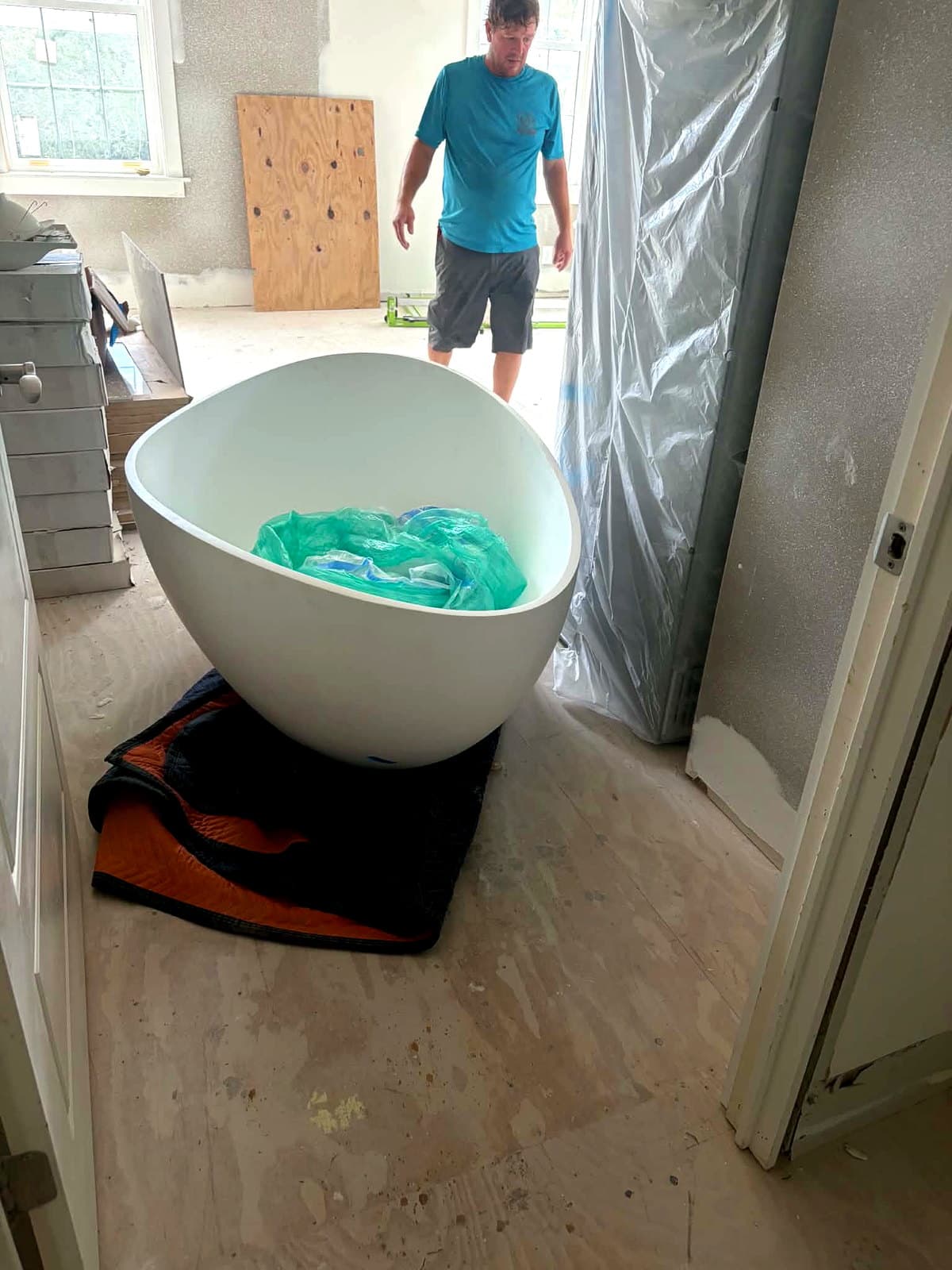
Keith spent part of last week in Seacrest Beach taking a freestanding soaking tub off a truck, through a house that was still under construction, and setting it down in a primary bath for the plumbers to connect. The job was for Home at Ease Interiors. Start to finish it was a small job — one item, one room.
It is also the job we get the most questions about, and almost none of those questions are about the tub. They are about whether the thing will fit, what happens if it gets chipped, who actually hooks it up, and why a single fixture is not just a cheaper version of a house move. So this one is less about the day and more about the answers.
How much does a freestanding tub weigh?
Empty, most of them land between 60 and 500 pounds, and the material decides which end you are on. An acrylic or fiberglass freestanding tub is usually 60 to 120 pounds — one person can tip it, two can carry it comfortably. Copper runs roughly 100 to 200. Solid-surface and stone-resin tubs, the thick matte ones that have become the default on 30A new builds, are commonly 250 to 450 pounds. Cast iron is 300 to 500 and up.
The number that surprises people is the filled weight, and it is not a moving number at all. Sixty gallons of water is about 500 pounds on its own. Add the tub and a person and a second-floor soaking tub can sit at 800 to 1,200 pounds in one spot on the floor. That is a framing question for your builder before the tub is ordered, not something a mover can solve on delivery day. We have never been asked to reinforce a floor and we would not be the right call if we were.
Will a freestanding tub fit through a 30-inch door?
Usually yes, but not for the reason people assume. The width of the tub is rarely the binding number. Most freestanding tubs are 59 to 72 inches long, 28 to 36 inches wide, and 22 to 33 inches tall. When a tub goes through a door it goes through end-on, so the dimension that has to clear the jamb is the tub's width or its height, whichever is smaller — never its length.
Clear opening is also not the same as door size. A 30-inch slab gives you roughly 28 to 29 inches of actual clear width once you account for the stop, and only if the door comes off its hinges first. A 32-inch door gets you to about 30 or 31. Pulling two hinge pins is the cheapest inch and a half in the trade and we do it before we do anything clever.
The turn is the real constraint, not the door
Almost every tight fixture delivery we have done failed or succeeded on a turn, not an opening. A 66-inch tub coming down a 36-inch hallway has to pivot into the bathroom door, and the geometry that matters is the hall width plus the door opening together — the diagonal you have to swing through. A generous door at the end of a narrow hall with a wall directly opposite is harder than a smaller door at the end of an open landing.
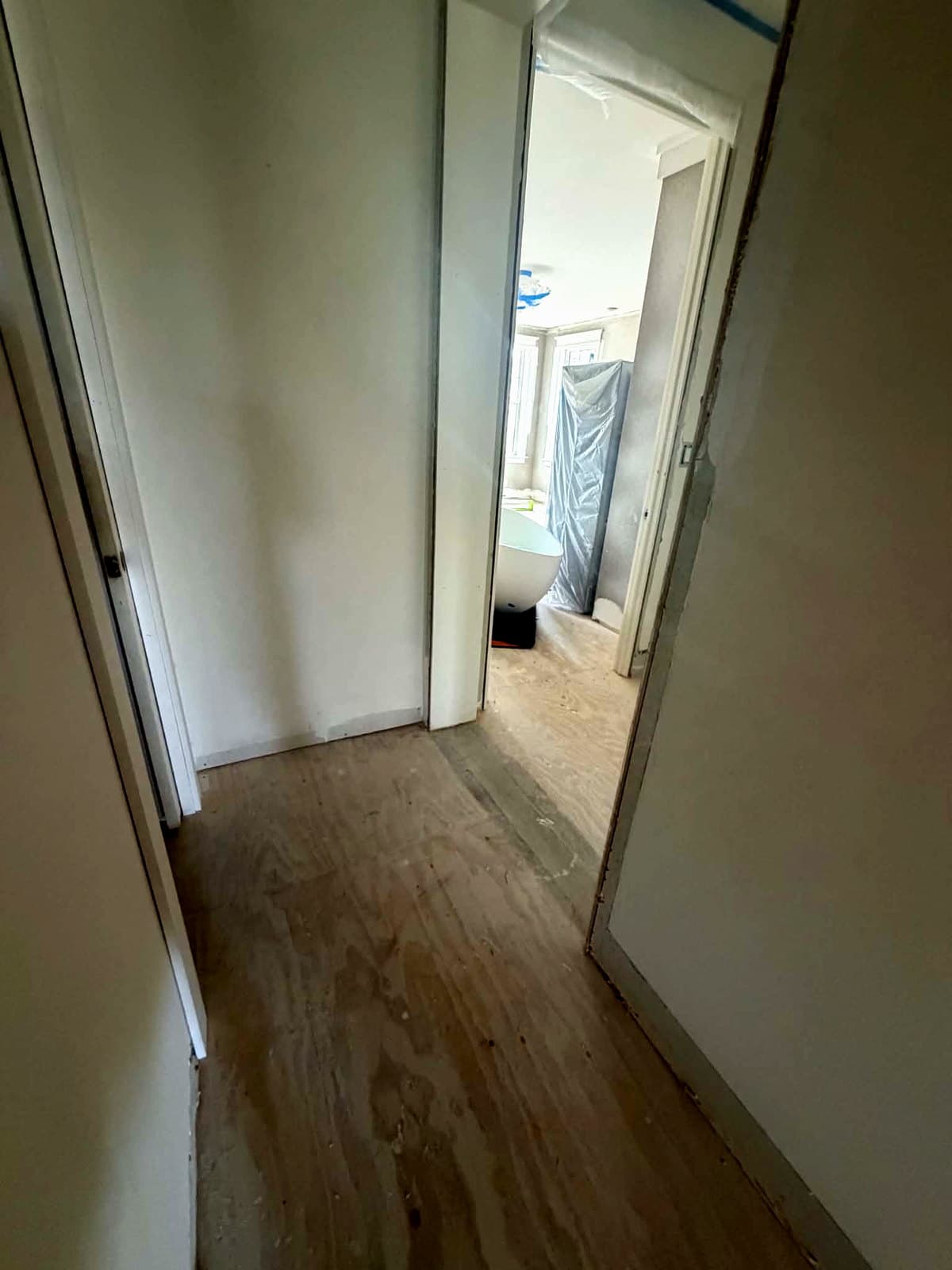
This is the approach on the Seacrest job. Two openings, a turn between them, finished jambs on both sides, and the tub visible at the far end where it ended up. We walk that path empty-handed before the tub leaves the truck, because the alternative is finding out with 300 pounds in your hands and nowhere to set it down.
How we carry them
Upright when we can. A solid-surface tub laid on its rim is putting its entire weight on the thinnest edge of the casting, and a stone-resin rim that gets set down hard on a subfloor screw will chip in a way that does not polish out. It rides padded, upright, on blankets, and it gets walked rather than rolled anywhere the floor is not already protected.
What does "set in place" actually mean?
Delivery and set-in-place are two different finish lines and it is worth getting the language straight before you book anything. Curbside delivery ends at the curb. Threshold delivery ends inside the front door. Room-of-choice puts the item in the right room and leaves it. Set in place means the item is in its final position, oriented correctly, and ready for whatever trade comes next.
For a tub, set in place means landing it square over the waste rough-in so the plumber's drain lines up without anyone dragging a 300-pound fixture two inches to the left. That last two inches is where floors get gouged and tubs get chipped, and it is entirely avoidable if the thing is set right the first time. That is the whole job. Everything else on our delivery and single-item moving page is a version of the same idea.
Do movers connect the plumbing?
No, and you should be wary of one who says otherwise. We place the fixture. A licensed plumber makes the connection. In Florida that is a licensed trade and it is not a grey area — our Florida mover registration covers moving your belongings, not making a waste or supply connection in your house.
The practical version of this is scheduling. The tub has to be in the room before the plumber's day, and it has to be in the right spot, or the plumber stands around or reworks the rough-in. On this job we went in ahead of them, which is why the photos have plywood on the floor and plastic on the walls and nobody else in the house.
Who is responsible if the fixture is already damaged?
This is the question designers and builders ask, and it is the right one, because an owner-supplied fixture on a jobsite has usually had a life before we get to it. It came off a freight truck, sat in a garage or a spare room for a few weeks with other trades working around it, and got moved at least once by someone who was not thinking about it. A chip found after delivery is very hard to assign to anyone once the crate is gone.
Our habit is boring and it works. We uncrate the piece and look at it before it goes on the truck, with the owner or the designer's rep standing there when someone is on site, and we note anything we find in writing before it moves. It costs ten minutes. It has settled more than one conversation that would otherwise have come down to two people remembering a crate differently. If you are hiring anyone else for this, ask them how they document condition at pickup and what their valuation coverage actually covers — if the answer is vague, that is your answer.
Is a single fixture priced like a house move?
It is billed the same way — hourly, with a crew sized to the item — but it does not behave like a scaled-down house move, and the hours do not scale the way people expect. A one-item delivery is mostly travel, assessment, and protection. The carry itself might be four minutes. Two movers who walk the path, pull a door, lay runners, and set a tub cleanly in twenty-five minutes have done the job correctly; two movers who skip all that and do it in nine have gambled with a fixture that costs more than the invoice. Our current rates are on the pricing page.
Crew size is the other variable. Anything under about 150 pounds with a clear path is a two-mover job. Solid-surface, stone, or cast iron on stairs or through a tight turn is three or four, because the failure mode of being one person short is not a slower job, it is a dropped tub.
Delivering into a house that is still under construction
Most of the fixture work we do on 30A happens in houses that are not finished, and that changes the job more than the item does. There is no driveway yet, or there is one and it is full of somebody else's trailer. The subfloor is exposed and every screw head is a hazard for anything with a finished bottom. Trim is in but unpainted, so a scuff is a callback for the painter. Gate codes at Seacrest, Alys Beach, Rosemary, and Watersound change, and a crew sitting at a gate is burning your hours.
So we ask for the code, the contact who is actually on site, and where we are allowed to park before the truck rolls. We bring our own floor protection rather than assuming a builder's is where we need it. And we do not leave anything in a traffic path for another trade to work around. We wrote more about protecting a house that is not finished yet in our new-construction move guide, and there is a companion field note from an install day on 30A with Design & Dwell Homes that covers the furniture side of the same situation.
When a fixture is its own job
A tub is one item, so people assume it belongs at the end of a moving day as a favor. It usually should not be. The tub arrives on the builder's schedule, not the homeowner's, and it needs the house empty of other trades for twenty minutes. Booking it as its own short call gets it done right, and it is the same reason we run appliance deliveries in Destin as standalone jobs rather than tacking them onto something else.
Showroom to site, receiving warehouse to site, freight terminal to site — that is a standing service for us, not a favor we do occasionally. We work with designers on the Emerald Coast regularly and most weeks we are in Seacrest Beach or one of the surrounding 30A communities anyway. Josh, Keith, Zack, and Les own the company and we are the ones who show up. There is no subcontractor between you and the person carrying your tub.
Frequently Asked Questions
How much does a freestanding bathtub weigh?
Empty, a freestanding tub typically weighs 60 to 120 pounds in acrylic, 100 to 200 in copper, 250 to 450 in solid surface or stone resin, and 300 to 500 or more in cast iron. Filled with water and a person, a standard 60-gallon tub can reach 800 to 1,200 pounds, which is a floor-framing question for your builder rather than a moving question.
Will a freestanding tub fit through a 30-inch door?
Usually yes. The tub goes through end-on, so the dimension that has to clear is its width or height — not its length. A 30-inch slab gives roughly 28 to 29 inches of clear opening once the door comes off its hinges. The more common obstacle is the turn from a narrow hallway into the bathroom, not the door itself.
Do movers install or connect a bathtub?
No. We set the tub in its final position, square over the waste rough-in, and a licensed plumber makes the connection. Making a supply or waste connection is licensed plumbing work in Florida and is outside what a moving company is registered to do.
What is the difference between delivery and set-in-place?
Delivery can end at the curb, the threshold, or the room. Set-in-place means the item is in its final position and oriented correctly for whatever trade comes next. For a tub, set-in-place means it lands square over the drain rough-in so nobody has to drag it once it is down.
How many movers does a freestanding tub take?
An acrylic tub with a clear path is a two-mover job. Solid-surface, stone-resin, or cast-iron tubs, or any tub going up stairs or through a tight turn, need three or four. Being one mover short on a heavy fixture does not make the job slower — it makes it a dropped tub.
Can you deliver a fixture to a house that is still under construction?
Yes. Most of the fixture work we do on 30A is into unfinished houses. We bring our own floor protection for exposed subfloor, work around unpainted trim, and need the gate code, an on-site contact, and a parking spot confirmed before the truck leaves.
Can you pick up a fixture from a showroom, warehouse, or freight terminal?
Yes. Showroom-to-site, receiving-warehouse-to-site, and freight-terminal-to-site fixture delivery is a standing service for us across Walton, Okaloosa, and Bay Counties, and we work with designers on the Emerald Coast regularly. We uncrate and document condition at pickup before anything goes on the truck.
How is a single-item fixture delivery priced?
It is billed hourly like our other work, with the crew sized to the item and the path. A single fixture is mostly travel, path assessment, and protection rather than carry time, so the hours do not scale down the way people expect. Current rates are on our pricing page.